AN IMPROV ESL CLASS CELEBRATING SAYING WHAT YOU THINK TO GET WHAT YOU WANT! (Course designed by ESL Instructor Ruth Schowalter and Improv Teacher Lesly Fredman)
Showing posts with label (c) Ruth Schowalter and Lesly Fredman extending scene using rules of improv. Show all posts

Saturday, May 5, 2012

IMPROV ESL LESSON ON STATUS AND SO MUCH MORE...


HIGH STATUS CLASS PHOTO
In the seventh week of our eight week program, our IMPROV ESL class at the Language Institute at Georgia Tech is rehearsing what we have learned this session. In other words, we are refining English speaking skills of rhythm and intonation while implementing the RULES OF IMPROV!

Today, we were once again visited by IMPROV TEACHER, Lesly Fredman, who is assisting me, Ruth Schowalter, ESL LANGUAGE INSTRUCTOR, in developing this IMPROV ESL class. The focus of our lesson today was STATUS. Here is a pictorial explanation of what occurred today, April 26, 2012.

IMPROV WARM-UP
Every improv class begins with a warm-up. These physical and vocal exercises allow student improvers to be present in the classroom. The idea is to relax one's mind and body in order to prepare for the challenging exercises requiring a clear mind.

GETTING GROUNDED TO PLACE

STRETCHING


FACIAL STRETCHES!


LOVING THE PHYSICALITY OF IT ALL. It is a pleasure to experience students away from their desks. They seem to delight in the physicality of being in their bodies. I believe this "being in the body" impacts their language learning positively!

PLAYING THE ELEVATOR GAME (Practicing focus and emotion)

The goal for this exercise was to get student improvers to focus on the emotions of another. When the elevator door opens and a new person gets on, the people already on the elevator have to understand the emotion the newly arrived person. They then "act out" the emotion in whatever way they can imagine. When the elevator door opens, one person gets off and a new person gets on with a "new and different" emotion. The improv exercise continues as players keep adjusting their emotion to the new arrival.


ENTERING THE ELEVATOR WHILE TALKING ON THE PHONE.  Ciro (center) gets on the elevator.  Student Imrpovers on either side of him are trying to figure out how to duplicate his emotional state, which doesn't mean that they have to be speaking on the phone.

WHAT'S GOING ON HERE? The other two students have exited the elevator. Tarek (left) has entered. Ciro is figuring out what to do. Is Tarek a druggy?

TIME FOR GOING DEEPER INTO CHARACTER. Lesly (right) gets on the elevator as sloppy drunk. Sephora at first tries to help Lesly. Instead, she is encouraged to become "intoxicated" like Lesly.


GOING FOR IT! Sephora (left) is able to play along with her partner Lesly. Remember in improv,  always take what your partner gives you. 

CHANGING THE EMOTIONAL STATE.  Both Lesly and Sephora waiting to see what Hamdan is going to "give" them when he gets on the elevator!
REVERSING STATUS (HEIGHTENING AWARENESS of STATUS)
In this improv exercise, the goal was to have one student begin the scene as "high status" and the other to be "low status." During the scene, the students were to slowly reverse status. To begin, the class has to give the improvers a setting and two characters.

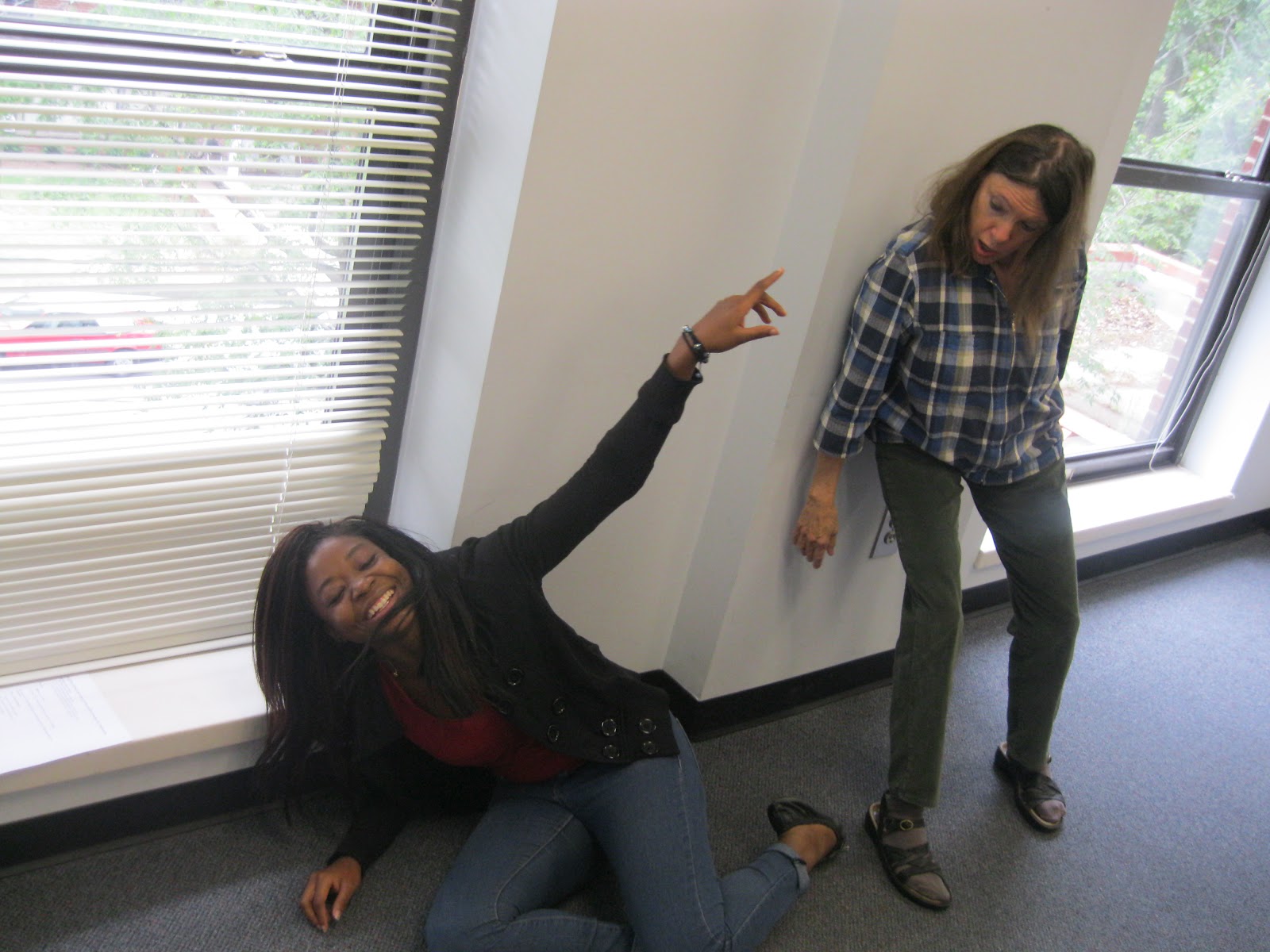
THE DEFENDANT AND THE JUDGE. Alejandra (left) begins the scene as a low status criminal. Hamdan is an unrelenting judge. Notice the body language. The students were also working with their voices.

REVERSE STATUS.  Now Alejandra has become high status! Look at the change in body language as Hamdan goes low status!

ENGAGEMENT.  Look how engaged the improvers and their audience is! IMPROV ESL is a wonderfully engaging language learning tool!
GUESS WHO IS LOW STATUS?. After seeing the two students above demonstrate REVERSE STATUS, the rest of the class did the exercise. I was slightly surprised when I asked the students to change the characters and setting that they didn't want to. Instead, they wanted to play their own version of the JUDGE and the CRIMINAL. When Ciro (left) became high status, he warned the Judge that he had eaten lots of people and he would eat the Judge too! Wow!

MORE ENGAGEMENT! LOOK AT THAT BODY LANGUAGE!
PARROTING (An Exercise in Focus and Teamwork)
This improv exercise requires students to pay close attention to one another and to work together. The students are asked to tell a story together at the same time. They must make eye contact with one another and look at each other's mouths. No one student makes the story up alone. Each student must contribute a piece of the story. It is challenging and fun!
DEMONSTRATION BY THE INSTRUCTORS.  Parroting is a slightly difficult exercise. The students needed to see it demonstrated to understand how to do it. Here Lesly (left) and I create a fairy tale by beginning with the words, "Once upon  a time..."


PARROTING BY KOREAN AND ARABIC SPEAKERS. How amazing it is to see two different language speakers create a story together in English. One thing that surprised me was how slowly the students spoke. One of the greatest challenges for "pronunciation" teachers like me is to get students to realize English as a time-based language and not a syllabic one. This exercise had students producing more English sounding pronunciation as they lengthened on the vowel.


A NATURAL REASON FOR EYE CONTACT AND GESTURES.  I love the way improv exercises give students "real" reasons for performing the body language we teach in theory. 
As the class came to an end we gathered for a class photo! The students chose the theme: STATUS. 


LOW STATUS.  Compare this class photo to the one that began this blog (which was high status)!  


That's it for now dear ESL IMPROVERS. Remember! Always make your partner look good!

Tuesday, April 24, 2012

IMPROV ESL: DEVELOPING CHARACTER INTO A MONOLOGUE OR POEM AND BUILDING A SCENE FROM IT

IMPROV ESL is a class that moves second language learners ahead in their production in using English and in feeling confident as they communicate their intentions!

During the seventh week of an eight-week course of IMPROV ESL, Lesly Fredman (improv teacher) and I (Ruth Schowalter, English language instructor) had international students at the Georgia Tech Language Institute do the following homework assignment! Please read the following:

Improv Homework #3: DEVELOPING A CHARACTER
(PART 2)


PART #2: WATCH SOMEONE YOU DON’T KNOW FROM A DISTANCE and CREATE an INTENTION

STEP #A: Choose a person who you don’t know that interests you, one that you can watch and take notes on. Observes this person for a little while and see what you notice about his/her behaviors. Listen.

STEP #B: As you take notes, decide on an “intention” something you want to get from this person:
·         Time
·         Directions to some place
·         Curiosity question about GT
·         Etc.

Using the skills of improv, approach the person and ask them your question. Thank them for the information and leave. Use their response in the monologue or poem that you are making in STEP #C.

STEP #C: Imagine a fictional life about him/her, including how they talk. Write a poem/monologue (Taylor Mali style) from this person’s perspective. Send me an email copy of your writing. Be prepared to present the poem or monologue to our class.


RATIONALE: In order to build a scene with interesting characters, improv students need to "be" characters other than themselves. One way for students to develop different characters is through observation. This assignment asks them to watch a "stranger" and to take notes on that person's behavior and create a poem or monologue from that "stranger's" perspective. By having students do this assignment outside the classroom, we hoped that the students would be more "alive" and "awake" in their environments beyond the walls of the classroom. They would then "engage" in a polite but brief exchange with this "stranger." Their observations and exchange would then result in the invention of a character from this real-life situation. And a poem that they would perform for the class.

REAL-LIFE RESULTS: Wow! The students brought their poems/monologues to class and succeeded in RECREATING the MOOD of their interactions. In fact they were so evocative that I thought the authors of the poems/monologues would enjoy observing two classmates build a scene from their work.

IMPROV RESULTS FROM POEMS/MONOLOGUES: Since the students have been working together using the RULES OF IMRPOV for six weeks, they were able to begin a scene after we had given the author feedback on the mood and intention and made sure of who the characters were. The goal was to start with one of the lines from the poem/monologue and to create something new. In other words, the scene had to be MORE than the written work. The written work served as the launching pad for going deeper.

WE HAD SO MUCH FUN AND MANY SURPRISES!
You will see some of the IMPROV ESL students' work here on this blog! Just imagine what scenes we built with them!

Remember! Always make your partner look good!